
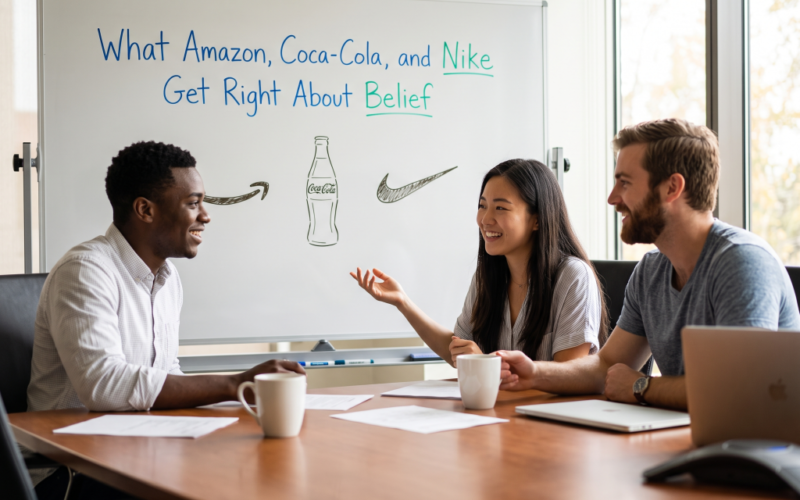

Advertising has spent a century learning how to make people fall for a brand. A new book argues the same instincts explain why some companies keep employees fascinated for decades while others burn through them in eighteen months. The Fascination Factor, by organizational psychologist André Martin and advertising creative director Mark Fitzloff, makes the case using three familiar names: Amazon, Coca-Cola, and Nike.
Start with Amazon. The company’s founding data point was a growth curve, not a customer insight: internet usage was expanding at 2,300% a year when Jeff Bezos got started, and he built a plan around selling books not because he loved them, but because they were the cleanest test case for the thing he actually wanted, which was to build the “everything store.” He named the company after the world’s largest river. His second choice for a name is more telling, and it still works as a live link today: type in Relentless.com and it redirects straight to Amazon.
Relentless is exactly the right word. Amazon didn’t turn a profit for nine years, and it didn’t build its culture around brand love, it built it around operational obsession. New hires read a six-page narrative memo before every meeting, the way some households say grace before dinner. The company’s leadership principles, “customer obsession,” “have backbone,” “leaders are right, a lot,” get recited like scripture, not printed on a poster and ignored. Bezos’s “Day 1” idea is treated internally as a belief system, not a slogan, and the company is known for paying non-believers to leave rather than let the culture erode by attrition. Whatever anyone thinks of the place, nobody who works there is confused about what it’s for.
Coca-Cola runs on the opposite fuel: myth, not mechanics. The formula sits in a vault nobody outside the company is supposed to see, guarded with the kind of ceremony usually reserved for national relics. Atlanta HQ has a soda fountain considered to pour the most perfectly blended syrup-to-water ratio in the world, which is a strange thing to be proud of until you realize it’s a ritual, and rituals are how belief gets transmitted without anyone having to explain it.
The company’s cultural gravity comes from the same well advertising has always drawn from: myth, memory, and mastery. The World War II soldier clutching a bottle in the Pacific. The “Hilltop” ad that promised to buy the world a Coke. Santa Claus, more or less as the culture pictures him today, is a Coca-Cola invention. The polar bears. Inside the building, there’s real reverence for all of it, including a corporate art collection that runs from Warhol to Rockwell.
Then there’s New Coke, one of the biggest brand failures in American history, and the cola wars that came with it. Most companies would bury that story. Coca-Cola tells it better than its critics ever could, because the mistake doesn’t threaten the myth, it deepens it. A brand that’s never stumbled reads as untested. A brand that stumbled and kept going reads as durable.
Nike built something stranger: a culture that never resolved the tension between the athlete and the artist, and instead put both types to work at the same time. Walk the Beaverton campus and the tension is visible on the sidewalk: buildings named for Jordan, Serena, and LeBron, employees in head-to-toe Swoosh hustling between them, half of them there for the competition and half for the design. Mark Parker went from shoe designer to CEO, which tells you which side eventually won the argument, or maybe that the argument was never meant to be won.
The company has its own scripture too: the story of the first Nike sole, made from a waffle iron a coach was willing to ruin for an idea. Swoosh tattoos. Internal competitions that have nothing to do with quarterly targets. And a genuine philosophy about testing: Nike doesn’t test its ads, it launches them, on the theory that feeling is a more reliable judge of whether something is good than a pre-screening will ever be. That’s a real risk, taken on purpose, over and over, and the culture treats the willingness to take it as a point of pride rather than a liability to be managed.
What’s useful about laying the three out side by side is what it says about fit. Amazon attracts people with thick skin, real ambition, and a bias for action. Coca-Cola draws people who want to join a legend already in progress: historians, global citizens, people who like lineage. Nike pulls in competitors with a creative streak, the kind of person who’d rather argue about a concept over pickup basketball than in a scheduled meeting. None of these cultures would work bolted onto the wrong kind of company, and none of them are trying to appeal to everyone, which is precisely why each one works as well as it does.
Three different companies, three different mechanisms, one shared decision: each let its real, sometimes unflattering history become part of the pitch, instead of scrubbing it for the annual report. Martin and Fitzloff’s point is that this isn’t a coincidence or a PR instinct. It’s the same rule that governs any brand built to last past a single campaign cycle: the story has to survive contact with reality, or it was never a story to begin with.
Most culture decks read like they were written by the legal department. The ones people actually want to work for read like they were written by someone who was there.
The post What Amazon, Coca-Cola, and Nike Get Right About Belief appeared first on Vanguard News.
This post was originally published on this site