

By Stanley Chidi Ebube
Lately, there have been dangerously daring, coordinated and worrisome attacks on security formations across the country. While these attacks bear certain similarities in their modus operandi, it is yet to be established whether they are centrally coordinated or are a result of a bushfire effect.
The Nigeria Police formations appear to be the most targeted, although within the period of these attacks correctional facilities and other security structures have also been under attack by the unidentified hoodlums.
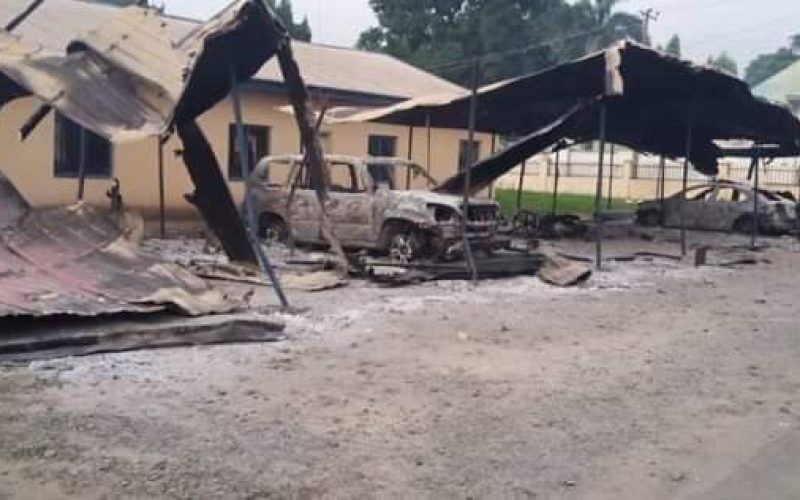
The most recent of these attacks on the police happened on April 19, when two policemen were killed during an attack on the Anambra Zonal Police Headquarters in Ukpo, Dunukfia Local Government Area. Vehicles and other valuables were also destroyed by the assailants.
The Police Public Relations Officer, Zone 13, Nkeiru Nwode, later said in a statement that operatives of the police attached to the zonal headquarters repelled the attack, recovered some arms and ammunition and killed some of the “criminal elements”.
“The attackers, who came in their numbers and shooting indiscriminately in order to gain access to the facility, were repelled by police personnel on duty, who showed profound gallantry in the face of the seemingly overwhelming attack,” she said.
On the same day, the police zonal headquarters was being attacked in Anambra, gunmen were also setting ablaze the Uzuakoli Police Station in the Bende Local Government Area of Abia State. Unconfirmed reports suggest that some detainees were released during the attack on the police station.
Between February and April, no fewer than 12 police officers have lost their lives to deliberate attacks and at least eight police formations have been burnt in the South-East and South-South alone.
Both the timeline and pattern of the attacks may not have immediately suggested a common motive and correlation, but the frequency and blatant inanity of these attacks, coming at a time when the overall national security architecture is stretched to its limits by the activities of insurgents, bandits, terrorists and other criminal perpetrators, call for concern by every well-meaning Nigerian.
Recall that on March 9, gunmen attacked a police station and burnt several vehicles in Imo State. Before then, some gunmen attacked a police station in Essien Udim Local Government Area of Akwa Ibom State, while another attack occurred at the Iboko Divisional Police Station in the Izzi Local Government Area of Ebonyi State, both on March 1.
On February 25 and 26, four police officers were killed at MCC Road in Calabar, Cross River State and gunmen burnt down a police station in Imo State, respectively.
Hoodlums had killed a police officer and burnt down a patrol vehicle in Ekwulobia in Anambra State on February 24, while two police officers lost their lives when gunmen attacked a police station in Aba, Abia State previous day.
And although the group has not come out to claim responsibility, the Indigenous People of Biafra (IPOB) has been accused of carrying out at least some of these attacks. Of course, IPOB cannot be exonerated, especially when attacks such as the recent one on two soldiers and three policemen in Omagwa, Ikwerre Local Government Area of Rivers State, is added to the mix.
Immediate-past Inspector General of Police, Mohammed Adamu, insisted IPOB was behind some of the attacks and the Nigeria Police Force had warned of “dire consequences” awaiting those engaged in attacking its formations and killing its officers, but the issue might require more than a subtle threat which may not, at this rate, deter those hoodlums from waging other attacks.
Also read: Abuja fire outbreak: Minister directs NEMA to assess damage for relief items
In other words, the cause of these heinous yet persistent attacks on police officers, buildings and equipment should be considered – thus treated – as deep-rooted.
In his foreword to the Policy Framework and National Action Plan for Preventing and Countering Violent Extremism launched in 2017, National Security Adviser (NSA) Babagana Monguno said Nigeria would ensure that violent extremist groups do not divide Nigeria and use the grievances in the country’s communities to their advantage.
The NSA’s statement is instructive. Online newspaper Premium Times quoted a security expert, Timothy Avele, as saying trust was the key ingredient missing in the relationship between the citizenry and the police. “There’s a lack of trust between the police and the general public before now. These new attacks will only widen the gap and lack of trust even more and that will not be good especially for the public in terms of police swift response to criminal activities and how cases are handled.”
An opportunity for confidence and trust-building presented itself recently when an Assistant Superintendent of Police, Sunday Erhator, was assaulted by a traffic offender at the Oniru area of Lagos. Video footage showed how Officer Erhator, although armed, displayed a high level of professionalism and restraint. Apart from being honoured by the Lagos State Government, spirited citizens were able to crowdsource the sum of one million naira for him through social media as a token of appreciation for his good deed.
If hoodlums continue to target the police for fatal and devastating attacks, it could trigger general apathy in the ranks of the police and affect how its officers and men carry out their duties of protecting lives and property. On the flip side, there is the need for an urgent trust-building initiative by the police in order for citizens to assuredly volunteer information that could lead to the apprehension and punishment of perpetrators of criminal activities in the society.
Ebube wrote in from Owerri
The post Incessant attacks on police formations and implications for insecurity appeared first on Vanguard News.
This post was originally published on this site